Accounting red flags that may trigger an audit by the Revenue Department
Eliminate tax risks: Transform high-risk financial statements into clean, audit-ready records.
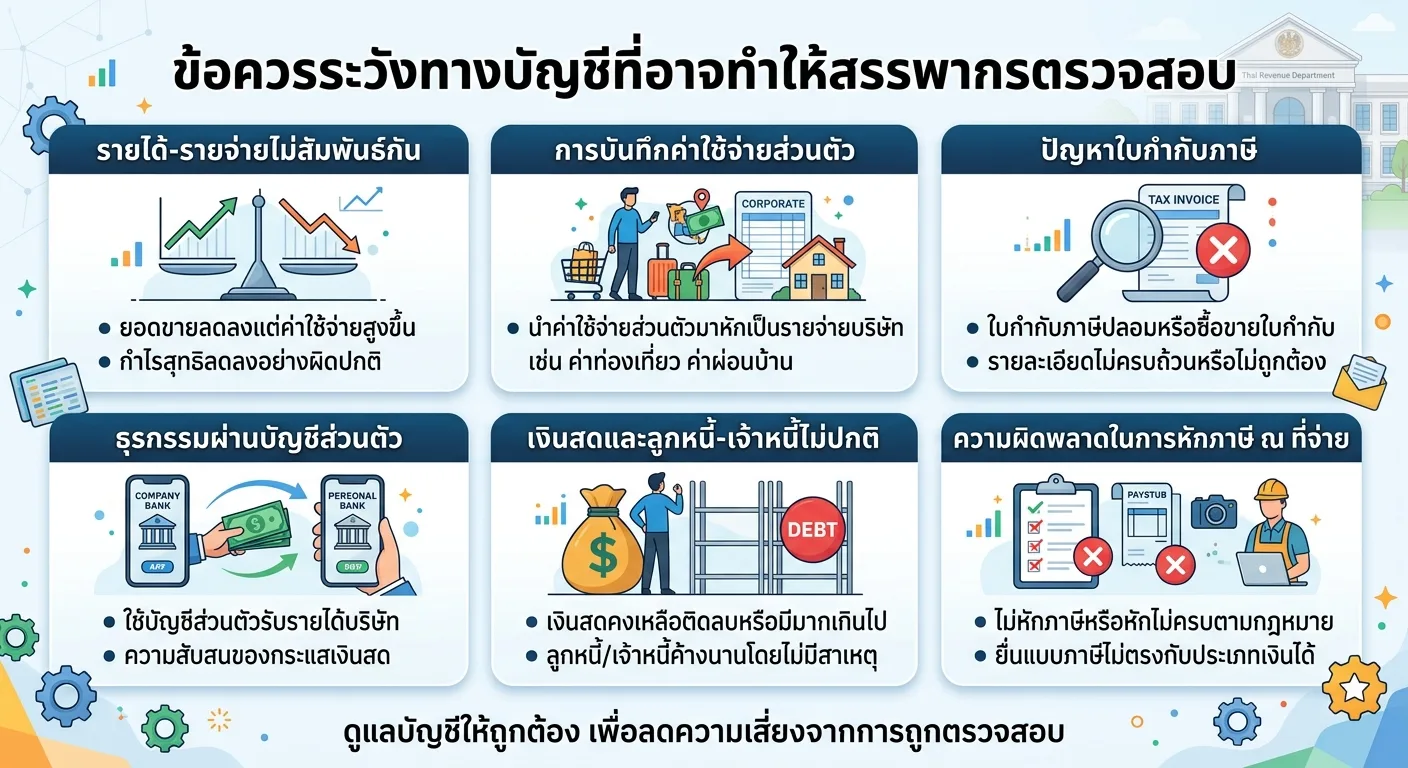
Accounting is more than just recording figures; it also requires vigilance regarding issues often flagged by the Revenue Department. Discrepancies or irregularities can lead to an audit or a request for clarification. Key accounting red flags that may trigger scrutiny from the Revenue Department include:
Revenue Inconsistencies
* Reported sales are unusually low compared to industry standards.
* Sales figures in the financial statements do not match those declared in tax filings (such as the PP.30 VAT return or PND corporate income tax return).
Unusually High Costs/Expenses
* Inflated or fictitious expenses, such as consulting fees, fuel costs, or advertising expenses.
* Expenses that do not align with revenue (e.g., monthly expenses nearly equal to monthly revenue).
Incorrect Tax Documentation
* Invalid tax invoices (missing VAT details, taxpayer identification numbers, or containing duplicate invoice numbers).
* Use of tax invoices identified by the Revenue Department as "fraudulent" or "fake."
Discrepancies Between Input and Output VAT
* Excessively high input VAT claims paired with unusually low output VAT.
* Failure to fully declare output VAT on sales of goods or services.
Cash and Bank Account Irregularities
* Unusually high cash balances on the balance sheet without evidence of actual physical cash on hand.
* Frequent, large-scale transfers between bank accounts without supporting documentation.
Loans Involving Shareholders or Directors
* Significant loans between the company and its directors that lack formal agreements or clearly defined terms.
* The Revenue Department may interpret such transactions as an attempt to evade taxes. Failure to file or late filing of tax returns:
Forms P.P. 30 (VAT), P.N.D. 3/53 (withholding tax), and P.N.D. 50 (annual corporate income tax return) — filing late or failing to file at all increases the risk of an audit.